Health and safety
Safety is our priority. Corbion is committed to creating a safe and healthy workspace with zero incidents. We firmly believe no job is so important that it cannot be done safely and with minimal environmental impact.
How we manage our impact: strategy and governance
Impacts, risks, and opportunities


Policies
To prevent adverse incidents, we have an Environmental, Health, and Safety Policy (new window) in place. Our commitment to achieve a zero-incident culture is based on our core beliefs:
Environment, health, and safety (EHS) is everyone's concern.
Safe behaviors prevail over business priorities.
We protect ourselves and our colleagues from unsafe situations.
Everybody should feel free to speak up.
Management leads by example.
Continuous improvement of our Environmental, Health, and Safety performance is essential.
We hold ourselves accountable.
We actively engage with our contractors.
Our policy is accessible on our website and is prominently displayed across all our global locations. The policy is applicable to all employees, contingent workers, and contractors across every site. The Chief Executive Officer, Chief Integrated Supply Chain Officer, and Head of EHS hold joint accountability for its effective implementation and adherence.
We expect our contractors to uphold similar standards on environmental and social responsibility, by meeting the standards of the Corbion Supplier Code. Our Supplier Code is based on the Guidelines for Multinational Enterprises from the Organization for Economic Co-operation and Development (OECD), the Ethical Trading Initiative (ETI) Base Code, the UN Guiding Principles on Business and Human Rights and the fundamental conventions defined by the International Labor Organization (ILO). Corbion offers guidance and support to suppliers in understanding and implementing the intent and requirements of the Supplier Code. Corbion verifies compliance with the principles of the Supplier Code through various methods such as self-assessments, third-party assessments, certification or on-site audits.
While our programs aim to reduce risks, employees are supported to get the best possible care if incident occurs. If an incident occurs, we support reintegration together with HR.
Engagement and processes
We approach our operations with meticulous care, prioritizing the safety, health, and well-being of our employees, contractors, and the communities we engage with. Our journey toward safety excellence is a collective effort, fueled by Visible Felt Leadership and supported by the Behavior-Based Safety (BBS) program. Risk reduction improvement initiatives are often lead by a BBS Task Force: small project teams focused on reducing risks, enhancing risk awareness, and promoting safe behaviors. Employees at all levels are encouraged to participate.
EHS Management System
Our operations are governed by Corbion’s global Environment, Health, and Safety (EHS) Management System, which defines the framework for how we manage risks, ensure compliance, and continuously improve our performance. This corporate system includes policies, procedures, training, and feedback mechanisms designed to meet applicable laws, regulations, and Corbion’s internal standards and codes.
We continue to strengthen and expand this system to ensure clear, consistent EHS expectations at every location. In 2025, efforts focused on consolidating the implementation of previously issued global practices and standards, while some new Process Safety related standards were also introduced. Our Global and Local EHS departments manage day-to-day health and safety activities in close collaboration with our quality and manufacturing teams, ensuring that requirements are understood and embedded across all sites.
Corbion remains committed to maintaining alignment with the ISO 45001 standard, and we continue working toward certifying all manufacturing locations. By the end of 2025, nine of our 12 active manufacturing sites were ISO 45001 certified, covering 96% of the exposed population.
The effectiveness of our programs is reviewed in the Operations Leadership Team and the Executive Committee.
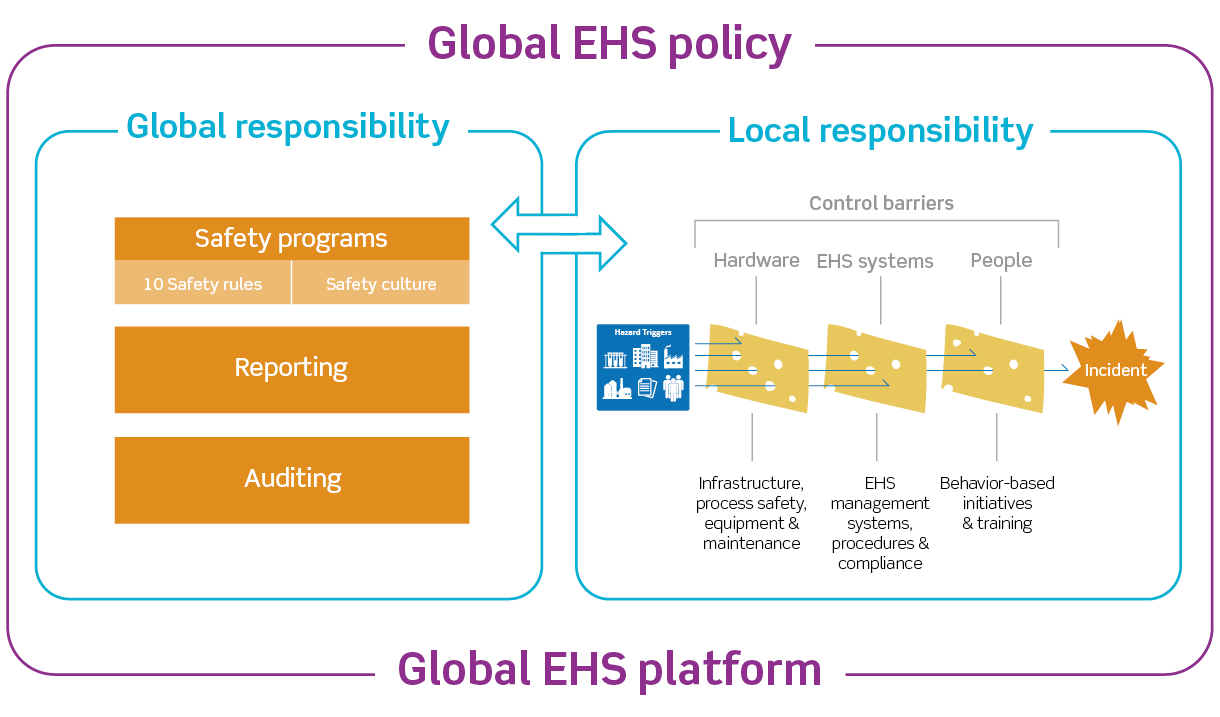
The framework below outlines the division of responsibilities within our EHS Management System between Global EHS and local sites:
Speaking up and reporting
Corbion’s management, employees, and contractors are committed to achieving a zero-incident culture. We promote an open and transparent work environment by encouraging all employees and contractors to voice their concerns, halt unsafe work practices, and report all incidents, near misses, unsafe situations, and suggestions for improvement to enhance our safety and environmental performance.
Reporting can be done by employees, contractors, and visitors through Sphera, our online incident management system. Reported events are reviewed, investigated, and monitored according to the Corbion Global EHS Incident Management standard.
Maintaining a safe work environment is embedded in our Code of Business Conduct. Therefore, if an employee cannot use other channels, they may raise their concerns (anonymously if desired) via our Speak Up Line, which is hosted by an independent third party. For Corbion’s external stakeholders, there is the dedicated online Speak Up Platform.
Global and local metrics and analysis of the reported events are shared regularly with employees. Locations have various ways of actively communicating with employees about their feedback and how this has influenced the plans and activities for the location, depending on the type, size, and culture of the location. Some examples are regular communications from each location’s EHS Steering committee, regular townhalls, safety dialogues in the field, etc.
Learning and sharing
Insights from (potentially) high-impact incidents or near-misses are documented in Safety Alerts and shared among all locations. To facilitate learning, locations also exchange insights and best practices through the Global EHS Platform (a network connecting EHS managers across the company), the Process Safety Platform (a network uniting process safety experts from the sites), and Site Director calls.
The Global EHS Platform is also the forum where the insights gained from the Sphera incident reports and from the broad variety of health & safety engagement activities which take place at the locations are shared between the locations and with the Global EHS team.
Behavior-Based Safety Task Forces
Our journey towards safety excellence is a collective effort. A key component of the Behavior-Based Safety program is the Task Force: small project teams aimed at reducing risks, enhancing risk awareness, and promoting safe behaviors. Employees at all levels are encouraged to participate.
Contractors
Contractors are fully integrated into our safety framework; they are provided with comprehensive onboarding and given on-site support. We identify and manage risk for contractors mainly through Work Permits or documented procedures for routine activities. Contractors can report incidents, near misses, unsafe conditions, and suggest improvements via Sphera. Incident investigations may be conducted jointly with contractor safety specialists. Regular meetings with 'house contractors' assess safety performance and explore improvements. The manufacturing site leadership is responsible for ensuring contractors’ safety is managed while on site (through onboarding, permits, audits, and incident management).
Performance
Targets
|
2030 Target |
2025 Target |
2025 |
2024 |
|
|
Total recordable injury rate (own workforce + contractors, per mln hrs) |
<1.25 |
<2.50 |
3.17 |
3.58 |
The total recordable injury rate (TRIR) is calculated as the number of recordable injuries per 1,000,000 hours.
The TRIR target is set by and reported monthly to the Executive Committee and the Global Integrated Supply Chain, and discussed in the Executive Committee and the Safety and Sustainability Committee of the Supervisory Board as per Sustainability governance.
Actions and progress
While we fell short of our own ambitions in terms of our safety performance target, we successfully reduced recordable injuries by 11% from the prior year. In this aspect of our business, no result greater than zero will ever be good enough. This is where 'preserving what matters' starts.
Felt leadership
The Executive Committee prioritizes safety-focused site visits at Corbion locations. They believe in the importance of direct safety dialogues with employees and contractors, and track safety observations and follow-up actions in the global management system. This is a continuous action.
Process safety capability and systems
Implementing a robust Process Safety Management system is crucial for reducing the risk of major safety and environmental incidents at our manufacturing facilities, such as fires, explosions, chemical releases, or spills. Our long-term goal is to foster a 'Zero Leak' culture, ensuring that all products stay contained within the pipelines. Strong Process Safety Management will therefore give us the best assurance that we control the risk of adverse impacts on the environment and communities in which we operate.
In 2025, we continued to strengthen our process safety capabilities and procedures further by
Offering Process Safety Management and Hazard and Operability (HAZOP) training.
Tracking progress of periodic HAZOP studies according to plans, as well as tracking the associated critical actions.
strengthening processes to manage safety critical equipment.
Strengthening pre-Startup Safety Review requirements.
Providing site-specific support across various global locations.
Behavior-Based Safety
The Behavior-Based Safety program, launched in 2022, aims to enhance site safety leadership and governance and to reduce risks through employee engagement at all 12 manufacturing locations and three R&D locations. Leaders are also learning about visible felt leadership, fostering open and positive safety discussions with employees and contractors. Employee engagement is measured at each site at the start of the program and again 12–18 months later through a survey, which assesses employees’ perceptions of and engagement in safety activities.
Eight out of 12 manufacturing locations and one R&D location have completed the project phase and are now advancing their safety initiatives with guidance from their safety steering committees. Moving forward, we aim to have all manufacturing location included by the end of 2026. The two remaining R&D locations will implement all key processes such as an effective safety steering committee and a behavioral observation program, by the end of 2027.
Global EHS Audit Program
In 2025, we continued evaluating our manufacturing and R&D sites for compliance with Corbion’s EHS standards. This internal audit covers all manufacturing locations and supplements ISO audits.
Internal and external ISO audits are conducted at these locations. Non-certified sites ensure compliance by following Corbion’s global EHS standards and Safety Rules. In addition, a third-party company conducts periodic “Loss prevention” surveillance audits on our locations, focusing on fire safety and emergency preparedness.
Metrics
For the definitions and where applicable limitations of the metrics, see Appendix 2.
|
Unit |
2025 |
2024 |
% change |
|
|
Fatalities own workforce |
# |
0 |
0 |
0% |
|
Fatalities contractors |
# |
0 |
0 |
0% |
|
% of own workforce covered by certified health and safety management system (ISO45001) - Operations |
% |
96% |
96% |
0% |
|
% of own workforce covered by Corbion's health and safety management system |
% |
100% |
100% |
0% |
|
Total recordable injuries (own workforce) |
# |
16 |
18 |
-11% |
|
Total recordable injury rate (own workforce, per mln hrs) |
# |
3.31 |
3.58 |
-7% |
|
Total recordable injuries (own workforce + contractors) |
# |
20 |
23 |
-13% |
|
Total recordable injury rate (own workforce + contractors, per mln hrs) |
# |
3.17 |
3.58 |
-11% |