Our sustainable solutions
Our Advance 2025 strategy builds on Corbion’s fundamental strengths by further focusing our business portfolio in alignment with global market trends and the opportunities related to sustainability. The majority of our solutions make a positive contribution to the United Nations Sustainable Development Goals. By focusing on the added value of sustainability, Corbion can tap into new markets, attract more customers, and ultimately drive further business growth. Our product portfolio includes the following sustainable solutions:
Corbion’s food safety, nutrition, pharma, and biomaterials solutions positively impact human health (SDG 3).
Corbion's food-ingredient solutions extend the shelf life of food products, which can reduce food waste at customers' operations or further downstream (SDG 12).
Corbion’s biochemicals enable customers to become more circular by switching to biobased alternatives, which helps to reduce the consumption of fossil resources (SDG 12).
Corbion's low-carbon solutions, especially our biobased portfolio, support the transition to a low-carbon economy, contributing to the mitigation of climate change (SDG 13).
Corbion offers omega-3 derived from algae fermentation as an alternative to traditional fish oil, a nature-based solution that reduces negative impacts on marine biodiversity (SDG 14).
These sustainable solutions can all be linked to specific downstream opportunities and positive impacts related to Climate change, Biodiversity, Circular economy, and Consumer health. Since we use a similar entity-specific metric for each of these topics, they are disclosed in this separate chapter which is focused on our positive impact and the related business opportunities.
How we manage our impact: strategy and governance
Impacts, risks, and opportunities
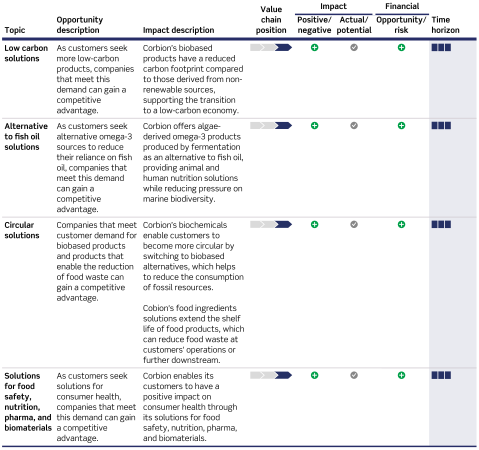
Our sustainable solutions are based on the following opportunities and positive impacts identified in the DMA. We do not have targets on opportunities related to our sustainable solutions as these are already covered by our financial targets.

Policies
Our Climate Policy includes a commitment related to the positive impacts of our low-carbon solutions, which support the transition to a low-carbon economy. We are dedicated to expanding the use of biobased products, thereby enabling the phasing out of fossil feedstocks for our customers. We do not address our positive impacts on Biodiversity, Circular economy, and Consumer health in policies.
Actions and progress
We assess new product development projects on their potential contribution to the United Nations Sustainable Development Goals (SDGs 2, 3, 12, 13, 14) to ensure that our innovation efforts are focused on increasing our positive impact on Consumer health, Climate change, Biodiversity, and Circular economy. The assessment is integrated into our innovation stage-gate process and guides the product developers on sustainability-related matters. This warrants that sustainability is an integrated part of the product design.
To ensure reliable information about the benefits of our solutions, we use Life Cycle Assessments (LCAs) to understand the environmental impacts of our products. An LCA can be used as a scientific basis to identify improvement opportunities, compare different products, and support decision making in new product and process development. We provide this information to customers to help them understand our products' carbon footprint and substantiate their sustainability claims. All Corbion LCAs are peer reviewed according to ISO 14040/44 and ISO 14067 standards.
In 2025, Corbion advanced its commitment to sustainable solutions through multiple initiatives across its business segments. In food applications, fermentation-based preservation systems help customers extend shelf life and reduce food waste. Our predictive modeling enhancements for natural mold inhibition further support food safety and shelf-life design. The new circular lactic acid plant in Thailand, which was launched in 2024, reinforces our role in enabling low-carbon, biobased solutions. Within Health & Nutrition, algae-derived omega-3 continued to scale, reducing pressure on marine ecosystems while supporting aquaculture sustainability. Meanwhile, our Biomaterials business delivered innovations in resorbable polymers and controlled drug delivery, improving patient health outcomes.
To monitor our impact, we track the overall contribution to the SDGs as a percentage of Corbion’s total revenues. In 2025, 79% of our revenues contributed to the SDGs.
Metrics
For the definitions and where applicable limitations of the metrics, see Appendix 2.
|
KPI |
Unit |
2025 |
2024 |
% change |
|
Net sales contributing to SDGs 2, 3, 12, 13, and 14 |
% |
79% |
74% |
7% |
|
Net sales contributing to Climate change (SDG 13) |
% |
20% |
18% |
12% |
|
Net sales contributing to Biodiversity (SDG 14) |
% |
12% |
11% |
5% |
|
Net sales contributing to Circular economy (SDG 12) |
% |
55% |
51% |
7% |
|
Net sales contributing to Consumer health (SDG 3) |
% |
44% |
42% |
5% |