Double materiality assessment
Introduction
Corbion uses the double materiality assessment (DMA) to hear the voices of our stakeholders and identify material impacts, risks, and opportunities. The assessment informs our sustainability strategy, business planning, and risk management, as well as the content of our Annual Report.
The DMA considers two perspectives:
The impact perspective (inside-out), which means investigating the impacts of Corbion and its activities on the environment and people, including on human rights.
The financial perspective (outside-in) which means investigating the risks and opportunities that sustainability matters present to Corbion’s financial performance.
Our DMA is updated at least every five years, with a light review conducted each year.
Double materiality process
In 2023, we started our DMA in line with ESRS definitions and requirements. In 2024 and 2025, we conducted a light review of our DMA to integrate organizational input and reflect insights from stakeholders and ongoing assessments, including our due diligence process and the 2025 human rights saliency assessment. The double materiality process followed a four-step approach.
|
Context & Stakeholder Identification |
Identify |
Assess |
Prioritize |
|
Value chain analysis as a basis to identify impacts, risks, and opportunities |
> 100 impacts, risks, and opportunities identified based on 22 sources, such as reporting standards (GRI, ESRS, SASB), ESG ratings, industry reports, and peer reviews |
> 500 stakeholders surveyed to understand what matters the most to different stakeholder groups |
External stakeholder interviews to validate outcomes |
|
Stakeholder identification to map stakeholders as affected or as users of information |
19 topics defined by categorizing impacts, risks, and opportunities and evaluating their position across the value chain |
> 10 interviews conducted with internal/external experts to gain insights on impacts, risks, and |
Executive Committee session to sign off on the process and outcomes |
|
2 expert panels – impact and financial materiality separately – to validate the outcomes and scoring |
Map material topics to applicable |
For more information on the double materiality process and supporting information around the methodology (such as the scope of the assessment and the scoring), see Appendix 3: Additional information on our DMA approach (new window). The outcome of these steps was discussed with and validated by the Executive Committee, resulting in the final list of material topics and impacts, risks, and opportunities.
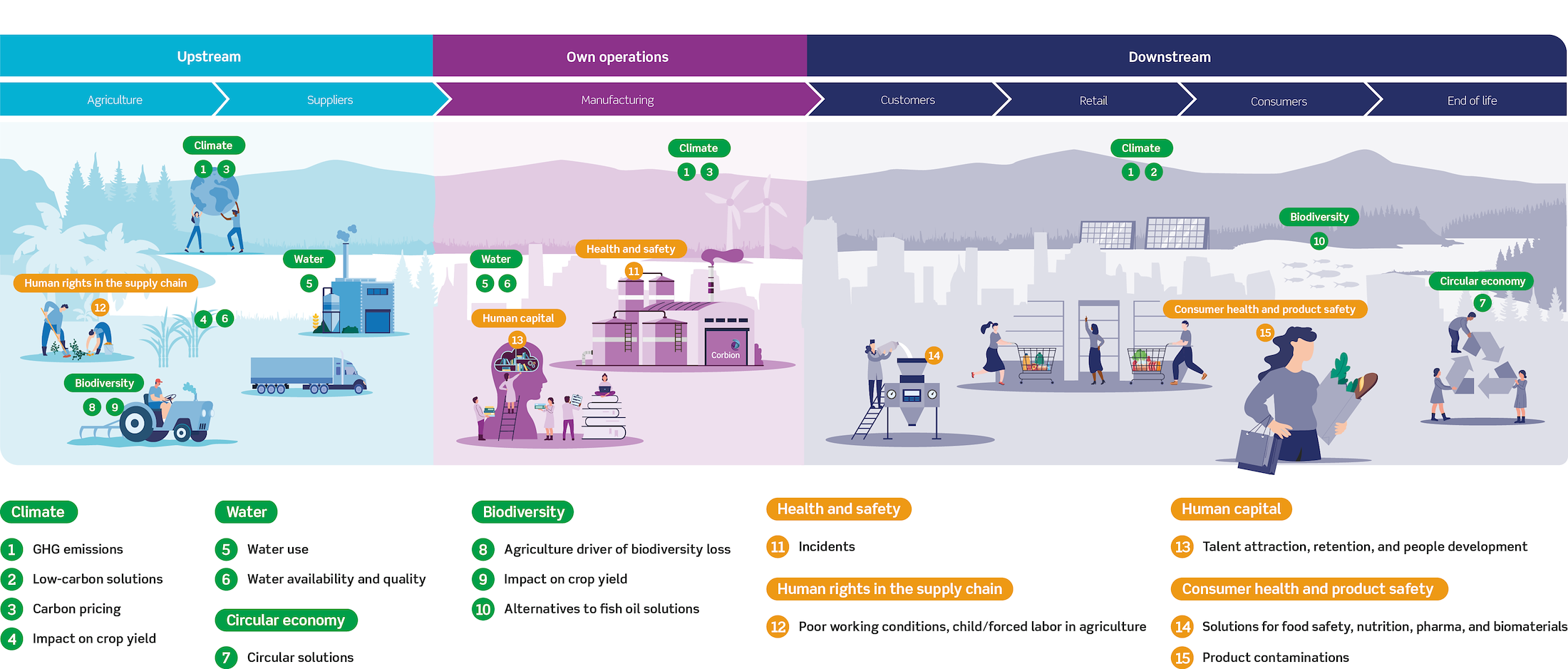
Our double materiality outcomes
|
Value chain position |
Impact |
Financial |
Link to full Impact, Risk, Opportunity (description in IRO table) |
|||||
|
ESRS |
Topic |
Impact, risk, opportunity - topic |
Positive/ negative |
Actual/ potential |
Opportunity/ risk |
Time horizon |
||
|
E1 |
Climate |
GHG emissions* |

|

|

|

|
||
|
Low-carbon solutions* |

|

|
|

|
|
|||
|
Carbon pricing |

|

|

|
|||||
|
Impact on crop yield |

|
|
|
|||||
|
E3 |
Water |
Water use |
|
|
|
|
||
|
Water availability and quality |
|
|
|
|||||
|
E5 |
Circular economy |
Circular solutions* |
|
|
|
|
|
|
|
E4 |
Biodiversity |
Agriculture driver of biodiversity loss* |
|
|
|
|
||
|
Impact on crop yield |
|
|
|
|||||
|
Alternatives to fish oil solutions* |
|
|
|
|
|
|||
|
S1 |
Health and safety |
Incidents |

|
|

|
|
||
|
S2 |
Human rights in the supply chain |
Poor working conditions, child/forced labor* |
|
|
|
|
||
|
S1 |
Human capital |
Talent attraction, retention, and people development* |
|
|
|
|||
|
S4 |
Consumer health and product safety |
Solutions for food safety, nutrition, pharma, and biomaterials* |
|
|
|
|
|
Consumer health and product safety; Our sustainable solutions |
|
Product contaminations* |
|
|
|
|
|
|||


The 2025 light review led us to expand on the potentially affected stakeholders reported under S2, workers in the supply chain, to also include non-agricultural workers.
These results of the DMA form the basis for Corbion’s 2025 Annual Report and Sustainability statements.