Water
Water is an essential resource for the planet, and for industry, agriculture, and energy production. We have a direct impact on the water cycle through the water we withdraw, consume, and discharge in our own operations. Indirectly, we affect the water cycle through the raw materials we use, which require large amounts of water to extract or produce.

Fermentation is our most water-intensive manufacturing operation. A significant portion of the water used in this operation is recovered in the later purification stage, then reused or discharged for wastewater treatment. Our net water consumption, therefore, only includes water evaporation in cooling towers and remaining water in products and byproducts.
For the upstream value chain, farmers use water for the irrigation of agricultural crops, such as sugar cane and corn. These crops are converted into carbohydrates by our suppliers and subsequently used as feedstocks for our fermentation processes.
Within the Science Based Targets Network (SBTN) corporate engagement program, we work with other stakeholders to create methods and tools for integrated target setting, amongst others for water, in line with the best available science. In 2023, Corbion was selected, together with 16 other companies, to pilot the target-setting process, which continued in 2024.
How we manage our impact: strategy and governance
Impacts, risks, and opportunities
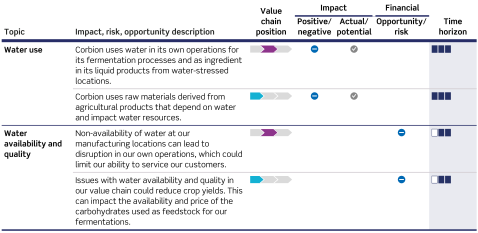
We used the insights obtained through our participation in the SBTN pilot to identify material impacts for Water.
In our direct operations, the highest-risk Corbion locations are Montmeló (Spain), Rayong (Thailand), Orindiúva (Brazil), and Campos (Brazil), which are all locations whose main activities involve fermentation and therefore withdraw significant amounts of water. Montmeló, Rayong, and Orindiúva are located in areas of high or extremely high-water stress. At the Campos site, we have experienced issues with water availability in the past years, therefore this is considered a high-risk site as well. These four sites represent 80% of total water withdrawal for Corbion.
Across our value chain, the highest risks relate to the sourcing of cane sugar and lime in Thailand, where we source high volumes of these materials from areas under water stress.
Policies
In 2023, Corbion introduced our Global Water Policy (new window), which applies to our manufacturing sites in all areas where Corbion operates and to our supply chain.
To preserve water resources, and to mitigate water-related risks for our own operations and in our supply chain, Corbion is committed to:
Assessing our dependencies and impact on water and marine resources by identifying and mitigating risks and opportunities.
Implementing water management practices, striving to minimize water usage, reduce effluents, and prevent pollution.
Improving water efficiency in our own operations at high-risk locations by decreasing water withdrawals, minimizing water discharge, and increasing water recycling.
Working with our suppliers and other stakeholders to manage water resources throughout the value chain, with focus on high-risk raw materials sourced in large volumes from areas under water stress.
Including sustainability assessments in our innovation process, to further minimize water use and pollution when developing new processes and products.
Providing transparency in our water performance by measuring, monitoring, and reporting relevant performance indicators for water and by disclosing the progress of our water stewardship program via the CDP water questionnaire.
Using water responsibly and adhering to all legally applicable environmental requirements.
To evaluate the policy's effectiveness, monitoring and review mechanisms are in place, including reporting and validation processes for all water KPIs.
Our water policy addresses both Corbion's impact and risks related to water. In addition, Corbion’s Sustainable Agriculture Policy (new window) outlines Corbion’s standards in relation to water use in its agricultural supply chain in more detail, to address the water risks in our agricultural supply chain.
The Chief Technology Officer, Chief Integrated Supply Chain Officer, and Head of Sustainability hold joint accountability for the implementation of these policies.
Corbion has not adopted policies related to sustainable oceans and seas, as it is not a material topic.
Performance
Targets
Corbion has not established consolidated, externally disclosed targets for water withdrawal, consumption, or discharge at group level. Water-related impacts, risks, and opportunities are highly location-specific and depend on local hydrological conditions, operational characteristics, and regulatory requirements. As a result, Corbion manages water primarily through a site-based approach, with priority given to locations classified as high risk.
The company’s current focus is on strengthening water stewardship at site level by embedding water considerations into business continuity planning, capital expenditure and innovation stage-gate processes, and by implementing targeted water-reduction and risk-mitigation initiatives informed by local water balance assessments. Performance is monitored through site-level KPIs and minimum water management practice requirements.
Corbion will continue to review the appropriateness of defining and disclosing consolidated water targets over time, taking into account the maturity of site-level water management, data quality, evolving regulatory requirements, and stakeholder expectations.
Actions and progress
Our water action plan includes the following actions by 2030:
Corbion sites classified as high risk regarding water will include relevant mitigation actions for their location in their business continuity plan. This will reduce the risk of issues related to water availability.
We will assess the level of maturity in water management practices for each Corbon site, and define mitigation actions if a site does not meet the minimal requirements. Our ambition is that all sites meet these minimal requirements by 2025.
In our upstream value chain, we will achieve >98% compliance with the Cane Sugar Code, which includes indicators on water. This will help mitigate the risk of water availability and quality issues, and their impact on crop yields and raw material pricing and availability.
We will include water as a topic in the innovation and CapEx stage gate assessment process, to ensure that our new processes and equipment improve water efficiency where possible.
We will launch water-reduction initiatives at remaining high-risk locations and continue existing water reduction initiatives.
In 2024, we defined minimum water management requirements for all active manufacturing sites. These include compliance with local water permits, water pollution control and monitoring protocols, reporting and investigation of water-related risks, and preventive maintenance programs. In 2025, we confirmed that all our active manufacturing sites meet these requirements.
In addition, we implemented measures to reduce water consumption in high-risk locations. At our site in Montmeló (Spain), we enhanced the efficiency of our water purification system and developed a roadmap of initiatives toward 2030. We also continued raising awareness of water scarcity and potential improvement opportunities by organizing learning sessions across sites. In Orindiúva and Campos (Brazil), comprehensive water balance assessments were conducted, leading to the identification of improvement opportunities that will be developed into projects and a roadmap for 2026. These opportunities include enhancing cleaning and carbon treatment processes, optimizing cooling towers to reduce water evaporation, and increasing water recycling. In Campos, actions implemented in 2025 focused on optimizing the filtered water production process and installing jet nozzles on cleaning hoses, thereby reducing water consumption during cleaning operations. We have not identified incidents requiring remedial actions.
In 2025, our combined actions for these three sites contributed to a 28% reduction in water consumption compared to the previous year. Overall water consumption for the sites at high-water risk areas increased by 9% because of the contribution of Rayong, including the ramp-up of the new circular lactic acid plant.
In our value chain, we continued the implementation of our cane sugar policy, which includes water-related requirements and applies to all cane sugar suppliers. For more information on these actions, see Biodiversity (new window).
The implementation of our water action plan involves colleagues from Procurement, Manufacturing, Engineering, Finance, and Sustainability.
Metrics
For the definitions and where applicable limitations of the metrics, see Appendix 2.
|
Water |
Unit |
2025 |
2024 |
% change |
|---|---|---|---|---|
|
Total water consumed |
m3 |
1,120,307 |
1,019,351 |
10% |
|
Water consumed in areas at water risk, including areas of high-water stress |
m3 |
1,017,180 |
932,115 |
9% |
|
Water recycled and reused |
m3 |
1,113,108 |
1,366,169 |
-19% |
|
Total water consumed per net revenue |
m3/mEUR |
882 |
765 |
15% |
Our 2024 water consumption and related KPIs are restated, mainly due to the inclusion of water consumed through purchased steam at our site in Orindiúva. This led to the following increase: Total water consumed +98,599 m3, Water consumed in areas at water risk of +53,119 m3, and Total water consumed per net revenue of +74 m3/mEUR. The restatement is made for comparison purposes.