
Climate change

The climate crisis threatens people, nature, and economies around the world, underscoring the need for urgent, decisive action. We are determined to fulfill our responsibility to preserve the climate, and to play a role in the transition to a zero-carbon economy. Our Advance 2025 strategy includes initiatives to reduce our carbon footprint in line with the ambition of keeping global warming below 1.5°C and we offer low-carbon solutions to enable our customers to reduce their emissions. Climate action is integrated in all aspects of our business activities, including financial planning.

How we manage our impact: strategy and governance
Impacts, risks, and opportunities
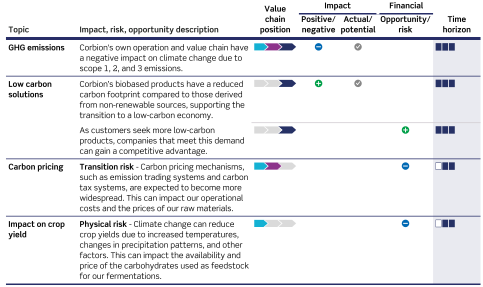
For disclosures related to our positive impact and opportunity on low-carbon solutions, see section Our sustainable solutions (new window).
Climate-related risks and opportunities assessment
Climate-related risks, including heatwaves, droughts, and water stress, have the potential to affect both our manufacturing sites and our value chain. We therefore update our climate-related impacts and risk assessment regularly, using the recommendations of the Task Force on Climate Related Financial Disclosures (TCFD). The TCFD distinguishes between two categories of climate-related risks: risks related to the transition to a low-carbon economy; and risks related to the physical impacts of climate change. The scope of our risk assessment includes all our manufacturing sites as well as our upstream and downstream value chain. Our downstream value chain analysis has been limited, as this is not where we see our main risks, nor do we have a large influence.
We distinguish between the short, medium, and long term in our analysis. For physical risks, we have used a different timeframe than for the DMA:
Short term: refers to the reporting year
Medium term: refers to time between the reporting year and 2030
Long term: refers to time between 2030 and 2050
The short and medium term aligns with our strategic and financial planning horizon, the long term with the lifetime of our assets, although this differs from asset to asset.
We have taken this approach to reflect the long timeframe over which climate and nature risks evolve. Our overall expectation is that transition risks are more likely to manifest in the short and medium term, while physical risks become more relevant in the long term. Our climate risk assessment methodology is aligned with our general enterprise risk methodology.
Scenario analysis
We have conducted scenario analysis to explore different plausible futures based on assumptions about societal development, demographics, economic growth, technology, and policy choices under different time horizons. We have determined our risks and opportunities within these scenarios to understand our resilience levels. We have considered the following two scenarios based on IPCC’s Shared Socioeconomic Pathways:
Taking the green road (1.5°C)
In this scenario, significant actions are taken to keep global warming well below 1.5°C above pre-industrial levels. This involves widespread adoption of renewable energy sources including biogas and hydrogen, increased energy efficiency, and global implementation of carbon pricing regulation, plus a strong focus on research and development of clean technologies, such as high-temperature heat pumps. Policies are implemented to promote sustainable development, reduce resource consumption, and protect ecosystems. Consumer preferences increase towards low-carbon, healthy, and nature-friendly products.
Taking the highway (4 – 5°C)
In this scenario, insufficient mitigation actions are taken to limit the greenhouse gas emissions, resulting in significant warming of 4–5°C. Continuing on a fossil fuel-based path, energy and commodity prices remain stable in the short-term, before being affected by climate disasters and other disruptions in the medium and long term. Climate hazards, such as droughts and reduced water availability, impact production continuity at our sites and decrease raw material availability. In this scenario, the transition risks are lower, as implementation of environmental policies is limited.
Building on climate‑risk workshops with senior management in each of our business units—where we assessed both transition and physical risks—we used the outcomes to further refine our methodology and validate the results. We have taken the following additional steps:
Own operations
In our considerations of the scenarios mentioned above, we used a climate-risk modeling tool to identify potential climate hazards at our manufacturing sites and how these would evolve over time. In this analysis the following climate hazards were included: extreme cold and heat, coastal flooding, hurricanes, intense precipitation, river flooding, water availability, and wildfire. The model results were further assessed by site management, who added site-specific know-how and experience. This enabled us to translate the climate hazards into company-specific risks, which are regularly updated as part of our business continuity risk assessment. Based on all these inputs, we conclude that physical climate risk is low in our own operations.
Value chain
In the value chain, we have focused our analysis on the main raw materials based on volume and sector vulnerability. Our analysis of agricultural raw materials included cane sugar, wheat, and corn dextrose, while lime and sulfuric acid were included as chemical raw materials. Together, these represent roughly 50% of our purchased raw materials. We excluded all other raw materials and other parts of the value chain such as transport and capital goods, taking into consideration time and resources versus expected risks.
When assessing climate risk in the supply chain, we used the same risk modeling tool to investigate sugarcane, our main agricultural crop, based on the same climate hazards as used for our own operations. Rising temperatures could reduce the crop yield of sugarcane by approximately 10% in Thailand in the mid-2050 scenario, based on current farming practices. We are therefore engaging with our sugar suppliers to understand possible adaptation solutions, including the use of new watering systems that contribute to lower evaporation levels. In Brazil, the climate model shows a flat sugarcane yield. Wheat and corn were assessed through desk research and expert interviews. Our investigation suggests that the climate impact on agricultural yields will be lower for these raw materials. For lime and sulfuric acid, the risk is related to potential increase in prices when carbon pricing materializes in the regions from which we source these chemicals.
Policies
Our Climate Policy applies to our manufacturing sites in all areas where we operate, as well as to our value chain (scope 3). Our policy aims to address Corbion’s impact on climate change as well as the physical and transition risks related to climate change.
Climate change mitigation and transition risks
Corbion is committed to:
Reducing greenhouse gas (GHG) emissions in line with the goals of the Paris Agreement, guided by the latest climate science through energy efficiency improvements and the use of renewable energy
Working with suppliers and other stakeholders in our value chain to reduce our scope 3 emissions
Investing in high quality GHG removals to neutralize remaining emissions that cannot be eliminated
Helping our customers reduce their carbon footprint by providing products with a low carbon footprint
To support these commitments, we use internal carbon pricing to increase awareness about the potential financial impact of GHG emissions and ensure that this is factored into our decision making. We do this by applying an internal carbon price of € 100 per metric ton of CO2e for all scope 1 and 2 emissions and use this as a sensitivity analysis in all investment decisions. This price was estimated by the UN as a minimum price required to meet the 1.5°C to 2°C scenario. For investments in the EU, we work with different EU ETS pricing scenarios, ranging from € 90 to € 150 in 2030. Across all our innovation projects, we take carbon impact into account through the sustainability assessment at each stage gate. The climate impact of innovation projects informs our portfolio management and prioritization.
Climate change adaptation and physical risks
Corbion recognizes the importance of adapting to the impacts of climate change and building resilience. Our main physical risk is related to our agriculture-derived raw materials. We engage with our sugar suppliers in risk areas to understand their resilience to climate change. Our Supplier Code, Cane Sugar Code, and Cane Sugar Policy include requirements related to climate change mitigation and adaptation. To learn more about our supplier policies, see Biodiversity (new window). To read about stakeholder engagement and the governance of all our policies, see General information (new window). Our Climate Policy and our supplier policies support the achievement of our CO2 reduction targets mitigating both our impact on climate and our transition risks. The CTO, CISCO, and Head of Sustainability hold joint accountability for the implementation of our Climate Policy.
Resilience of our strategy to climate change and nature-related risks
Using the outcome of the impacts, risks, and opportunities under the different climate scenarios, we have assessed the resilience of our strategy and nature-related risks to climate change in 2025. We have involved proxies of indigenous/local knowledge holders in our double materiality assessment, and their input was used in this assessment.
Taking the green road
In this scenario, consumer preferences towards low carbon, healthy, and nature-friendly products increase, and significant actions are taken to promote sustainable development, reduce resource consumption, and protect ecosystems. Corbion’s Advance 2025 strategy invests in key growth areas such as natural food preservation, algae-derived ingredients, lactic acid derivatives, and natural polymers. These investments allow Corbion to take advantage of opportunities related to Consumer health, Climate change, Biodiversity, and Circular economy. This allows Corbion to capitalize on the developments in this scenario. Through implementation of our Climate Mitigation and Transition Plan, we will reduce our GHG emissions, which mitigates the risk of carbon pricing.
Taking the highway
In this scenario, temperatures will rise 4-5°C degrees, which leads to increased physical climate risks, especially in our upstream value chain. We mitigate these risks through our security of supply program, our responsible sourcing program, our business continuity program, and our global manufacturing footprint. Through these programs, we can ensure operational continuity even if certain suppliers or regions face climate or nature-related challenges. We source ingredients from multiple regions, reducing our dependence on any single climate zone and maximizing stability if extreme weather impacts specific areas. Moreover, we work closely with our suppliers to adopt sustainable farming practices that enhance soil health and water conservation, reducing the impact of climate change. Based on our current assessment, we do not expect the impact of physical risks on our own operations to be significant. Our global footprint mitigates potential supply chain disruptions. Climate and nature risk assessments are integrated in our business continuity planning to ensure that we take appropriate mitigation measures where needed. In this scenario, business opportunities related to low-carbon products will be less relevant. We expect that other trends will not be materially different.
We do not expect that either climate scenario will lead to significant workforce re-skilling, nor to impact our financing. We acknowledge that our method for identifying impacts, risks, and opportunities is prone to many uncertainties and that our methodologies can be further developed, to make more accurate assessments. In the coming years, we intend to increase the scope of our value chain included in the assessment, and to increase the accuracy of our risk quantification. In addition, the assumptions in the climate scenarios are high level and include a limited number of assumptions. The assumptions can be further detailed in the future. The physical climate risk assessment is based on geospatial coordinates (in 25km2 resolution) of our sites and cane sugar suppliers.
Financial resilience
We have not identified any risks or opportunities that have influenced our Financial statements in the reporting year. In addition, in neither climate scenario did we identify any risks or opportunities that have materially influenced our Financial statements.
Climate Mitigation and Transition Plan
Our Climate Mitigation and Transition Plan was approved by the Executive Committee and the Supervisory Board. It applies to our entire value chain.
Scope 1 and 2 roadmap
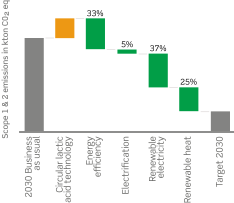
To align our global operations with the realization of a low-carbon future, we have developed a detailed roadmap based on the following decarbonization levers:
Decarbonization levers for scope 1 and 2:
Reducing our energy consumption through energy efficiency. Specific actions include replacing outdated, inefficient equipment with energy-efficient models, improving insulation, and installing smart management systems for real-time monitoring of energy consumption.
Electrification of fossil-fuel driven systems. Specific actions include the installation of heat pumps and mechanical vapor recompression.
Implementing renewable electricity solutions to reduce emissions from energy generation. Specific actions include the installation of solar panels on site and the purchase of off-site renewable electricity, through power purchase agreements, or by purchasing renewable electricity certificates.
Introducing renewable heat solutions to support our transition from fossil fuels to renewable alternatives such as e-boilers, biogas, and hydrogen.
Process innovation to decarbonize the lactic acid production process.
We have been implementing renewable electricity solutions for more than five years, and as of 2025 our operations are fully powered by renewable electricity. Actions related to energy efficiency and electrification are ongoing, starting with projects that are financially most attractive. We expect the financial attractiveness of these projects to improve over time, with evolving carbon pricing regulations. Actions related to renewable heat and process innovation are currently in the investigation stage. Achieving our 2030 goal remains highly challenging. While several technical and operational pathways have been identified, their successful implementation depends on improving business cases, securing sufficient investment, and establishing effective collaborations and supportive policy frameworks. We aim to start the implementation of renewable heat solutions at some locations by 2030, which will continue between 2030 and 2040. Implementation of process innovations related to lactic acid is planned after 2030.
Scope 3 roadmap
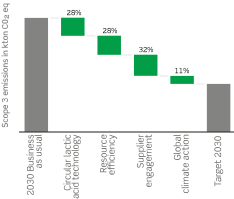
Decarbonization levers for scope 3:
Process innovation to decarbonize the lactic acid process. An example is the new circular technology for lactic acid which is implemented in our new lactic acid facility in Thailand. While this technology reduces scope 3 emissions, it does lead to an increase of our scope 1 emissions due to the increased use of energy to enable the recycling of process chemicals. Net cradle to gate emissions are reduced.
Implementing resource efficiency measures to reduce consumption of raw materials and waste generation. Specific actions include continued R&D to further improve process circularity, additional process optimization initiatives, and collaborations with supply chain partners to valorize waste where possible.
Engaging with suppliers to promote climate action in our supply chain. Specific actions include raw material certification, collaboration to identify emission-reduction opportunities, and pilots with strategic suppliers.
Through global climate action, national grids will use more electricity from low-carbon sources. This will further support our scope 3 reductions.
All of these actions are ongoing and will continue beyond 2030. Achieving our 2030 goal remains highly challenging. Progress in areas such as supplier engagement and global climate action also depends on external stakeholders. These areas are therefore less within our direct control and rely on effective collaboration and broader systemic change.
To deliver on our net-zero commitment, we will neutralize remaining unabated emissions (< 10%) through carbon removals and permanent storage solutions. We closely follow relevant developments in this field and will invest in high-quality neutralization of any residual emissions (beyond 2040).
Corbion does not have long‑term locked‑in GHG emissions, as the energy sources at our sites can be transitioned to renewable alternatives. Residual scope 1 and 2 emissions cannot be eliminated immediately due to financial and technological constraints; based on current plans, emissions occurring up to 2030 can be considered locked‑in (estimated at 86 kt CO₂ in 2030, market‑based). Beyond 2030, further reductions are planned, but locked‑in emissions cannot yet be reliably quantified. In addition, we produce biobased products, so we only have biogenic emissions from our products, not accounting as GHG emissions.
Capital allocation
Our transition plan aims to transition our current assets to net zero by 2050 in the most cost-effective way, through process improvements, by replacing fuel sources with renewable sources, and by implementing new technologies. This includes retrofitting existing assets.
To achieve the goals outlined in the roadmap above, we have developed an investment plan for 2025-2030. It defines over 50 specific projects for our Corbion manufacturing sites, including CapEx estimations for each project. These projects are essential steps on our roadmap to achieve our targets.
In the medium-to-long term, the transition plan will require considerable additional investment, for which a balanced decision must be made between investments. External developments such as regulation, subsidies, carbon pricing, net congestion, the availability of cost-effective renewable energy sources, development of low carbon technologies as well as our business performance, may impact our ability to allocate resources to our roadmap. Projects are prioritized based on payback time and in alignment with other CapEx projects; this maximizes synergies and ensures focus on high-impact areas. Some of our roadmap projects have challenging business cases. As we prioritize based on payback time and CapEx is restricted, this can pose challenges in meeting our target.
Climate mitigation capital allocation until 2030
Environmental transparency and accountability are vital for tracking progress towards a low-carbon economy. Corbion reports its environmental data through CDP, to provide transparency to investors, customers, and other stakeholders. CDP is the gold standard for corporate environmental reporting and is fully aligned with the TCFD recommendations.
Climate adaptation plan
We engage with our sugar suppliers in risk areas to understand their resilience to climate change. Our Supplier Code, Cane Sugar Code, and Cane Sugar Policy include requirements related to climate change mitigation and adaptation.
The implementation of our Climate Mitigation and Transition Plan and adaptation plans involve colleagues from Manufacturing, Engineering, Finance, and Sustainability, and Procurement.
Performance
Targets
To ensure that our climate goals are based on the best available science, we have adopted the Science Based Targets initiative (SBTi) as a framework for setting and validating our targets. Following the divestment of our Emulsifiers business, we have updated our emissions-reduction targets, in line with the latest SBTi requirements. We are committed to reducing our absolute scope 1 and 2 emissions (market-based) by 42% and our absolute scope 3 emissions by 25% by 2030, compared to 2021. We are also committed to reach net-zero GHG emissions across the value chain by 2050. The scope of the target is all Corbion sites and offices for scope 1 and 2 emissions and includes 67% of scope 3 emissions in line with SBTi requirements, thereby focusing on high-emission categories where we can make an impact. With these targets, we aim to comply with the criteria for inclusion in the EU Paris aligned benchmarks. See Stakeholder engagement (new window) for more information on how our stakeholders were involved in setting targets.
|
E1 - Targets |
|||||
|---|---|---|---|---|---|
|
2050 Target |
2030 Target |
2025 Target |
2025 |
2024 |
|
|
Absolute scope 1 and 2 emissions reduction (SBTi-approved target) |
90% |
42% |
n/a |
17% |
25% |
|
Absolute scope 3 emission reduction (SBTi-approved target) |
90% |
25% |
n/a |
15% |
7% |
|
Renewable electricity |
100% |
100% |
100% |
100% |
99% |
Our base year represents our current inventory and typical GHG profile, selected based on the SBTi guidelines for choosing a base year. Base year emissions are reviewed annually to ensure compliance with SBTi requirements and the GHG protocol. If the cumulative impact of all changes to the base year inventory is equal or higher than 5%, the base year is adjusted with the latest information available.
Changes in targets and metrics
In 2025, SBTi has validated that the science-based greenhouse gas emissions reduction targets submitted by Corbion conform with the SBTi Standards and Guidance.
Actions and progress
Compared to 2024, our scope 1 and 2 emissions increased due to business growth and the ramp-up of the new circular lactic acid plant in Thailand. Our new circular lactic acid technology enables the recycling of processing chemicals, reducing scope 3 emissions, which consumes additional energy compared to the conventional lactic acid process, leading to an increase of our scope 1 emissions. The further ramping up of this plant therefore had a positive impact on our scope 3 emissions, which decreased significantly compared to last year. Overall, the cradle-to-gate GHG emissions of the new technology are >30% reduced compared to the conventional lactic acid production in Thailand.
Actions taken in 2025 for our scope 1 and 2 emissions
In 2025, we revised our roadmap to achieve the 2030 targets. All reduction areas remain relevant, and we continue to focus on each of them. Achieving our 2030 goal remains highly challenging. While several technical and operational pathways have been identified, their success depends on improving business cases, securing sufficient investment, and fostering effective collaborations supported by policy frameworks.
Over the past year, we gained deeper insights, which led to adjustments in feasibility and timing. For example, implementing renewable heat solutions in Thailand and the US before 2030 is not realistic due to current energy prices, which favor the use of natural gas over electricity and renewable fuels. Opportunities have been further developed, and new ones identified, including process innovations related to lactic acid, which are planned after 2030. Our roadmap remains a living document, regularly updated with the latest insights to reflect evolving conditions and priorities.
Energy efficiency
We implemented the first energy-saving project identified by the energy scan at our Blair (US) site, focusing on improvements to the steam system. Additional opportunities will be rolled out in the coming years on energy saving.
In Gorinchem (the Netherlands) the energy scan is being updated. First improvement projects are implemented in 2025, like insulation improvements and replacements of pumps.
In Montmeló (Spain) we have implemented several projects related to steam reductions that were identified in the last years. For the coming years, additional measures have been identified for energy reduction in Montmeló.
The implemented real-time monitoring of our steam consumption in Gorinchem, has highlighted procedure and process improvements that are partly implemented in 2025. The remaining will be implemented in 2026. The implementation of real-time electricity monitoring is ongoing, and we have expanded this activity to our locations in Brazil.
We have updated the longlist of energy reduction projects with new insights into energy prices, CapEx projections, and subsidy opportunities. Based on this, the roadmap towards 2030 has been updated.
We set site-specific energy efficiency targets for the six manufacturing sites with the highest energy consumption. Four sites have met their site-specific target in 2025. Next to energy savings, these targets also led to increased awareness, ownership, and commitment among colleagues.
Electrification
We have installed an electrically-driven evaporator in Gorinchem in the second quarter of 2025.
We evaluated the feasibility of electrically-driven evaporators and heat pumps for different parts of our processes. The resulting projects have been included in our 2030 roadmap.
Renewable electricity
In 2025, we implemented renewable electricity at our remaining two sites, completing the transition across all operations. As a result, we successfully achieved our 2025 target of 100% renewable electricity coverage.
Renewable heat
We continued the evaluation of feasible alternative fuels for heat production at our sites in Gorinchem (the Netherlands), Montmeló (Spain), Blair (US), and Rayong (Thailand). Alternative fuels are not realistic in Thailand and the US in the coming period, especially due to the price difference between natural gas and electricity. We are evaluating the implementation of an e-boiler to electrify steam production at our Gorinchem site, though this option is unlikely to be operational before 2029.
Process innovation
We continued our long-term innovation program and initiated several new projects.
Actions taken in 2025 for scope 3 emissions
In 2025, we revised our roadmap to achieve the 2030 targets. Meeting these objectives remains highly challenging, particularly for scope 3 emissions, where progress is slower than anticipated. This is largely due to the global slowdown in climate action, which has hindered supplier engagement and reduced the potential for emissions reductions across our supply chain. These areas are not fully within our direct control and require effective collaboration with external stakeholders, as well as broader systemic change.
Raw material efficiency
In 2025, we focused on improving the efficiencies in our new circular lactic acid plant in Thailand. While this innovative process significantly reduces environmental impact, it still generates some waste and is not yet fully circular. Lactic acid produced by this first-of-its-kind facility will have the lowest associated carbon footprint compared to any manufacturing technologies currently used. The recycling of processing chemicals eliminates the use of lime, which is a significant contributor to our scope 3 GHG emissions.
We continued our long-term innovation program with a stronger focus on yield improvement by developing new purification technologies.
Supplier engagement
We continued engaging and supporting suppliers in the development of their CO2 reduction plans, focusing on high-impact suppliers.
We collected primary data for approximately 71% of GHG emissions from raw materials included in our 2030 target scope.
Engagement with our chemicals suppliers resulted in the implementation of renewable electricity (ISCC plus certified) for two of our raw materials from 2025 onwards.
Logistics
We increased the use of intermodal freight transport over truck transportation in the US, resulting in an emission reduction of 0.6 kton annually.
We have implemented EV trucks for on-site movements in Totowa (US).
Thanks to recent legislative changes in Brazil, we were able to consolidate multiple truckloads, reducing costs and cutting CO₂ emissions by approximately 1.0 kton per year.
We have evaluated multiple CO₂ calculation software modules that can integrate with our logistics data to enable more accurate measurement of logistics-related emissions.
Metrics
For the definitions and where applicable limitations of the metrics, see Appendix 2.
|
Energy |
Unit |
2025 |
2024 |
% change |
|
|---|---|---|---|---|---|
|
Final energy consumption and mix |
Non renewable |
||||
|
Fuel consumption from coal and coal products |
MWh |
- |
- |
0% |
|
|
Fuel consumption from crude oil and petroleum products |
MWh |
- |
- |
0% |
|
|
Fuel consumption from natural gas |
MWh |
319,863 |
282,175 |
13% |
|
|
Fuel consumption from other fossil sources |
MWh |
18,286 |
18,648 |
-2% |
|
|
Consumption of purchased electricity from fossil sources |
MWh |
- |
4,017 |
-100% |
|
|
Consumption of purchased steam from fossil sources |
MWh |
284,561 |
273,111 |
4% |
|
|
Total non-renewable energy consumption |
MWh |
622,710 |
577,951 |
8% |
|
|
Share of fossil sources in total energy consumption |
% |
62% |
61% |
3% |
|
|
Renewable |
0% |
||||
|
Fuel consumption from renewable sources, including biomass |
MWh |
24,671 |
20,656 |
19% |
|
|
Consumption of purchased electricity from renewable sources |
MWh |
274,672 |
267,619 |
3% |
|
|
Consumption of purchased steam from renewable sources |
MWh |
80,615 |
87,997 |
-8% |
|
|
The consumption of self-generated non-fuel renewable energy |
MWh |
212 |
513 |
-59% |
|
|
Total renewable energy consumption |
MWh |
380,170 |
376,784 |
1% |
|
|
Share of renewable sources in total energy consumption |
% |
38% |
39% |
-4% |
|
|
Total energy consumption |
MWh |
1,002,880 |
954,735 |
5% |
|
|
Energy intensity |
Total energy consumption per net revenue |
MWh/mEUR |
789 |
717 |
10% |
Gross scope 1, 2, 3 emissions, and total GHG emissions (tons CO2e)
|
Scopes and Categories [Ton CO2e] |
Base year |
2025 |
2024 |
% change |
|---|---|---|---|---|
|
Scope 1 |
||||
|
Scope 1 emissions |
94,744 |
68,899 |
58,069 |
19% |
|
Percentage of scope 1 GHG emissions from regulated emission trading schemes |
43% |
43% |
54% |
-21% |
|
Scope 2 |
||||
|
Scope 2 emissions Location-based |
87,917 |
113,345 |
112,997 |
0% |
|
Scope 2 emissions Market-based |
53,473 |
53,469 |
52,420 |
2% |
|
Scope 3 |
||||
|
Total scope 3 emissions |
880,077 |
739,358 |
768,519 |
-4% |
|
1. Purchased goods and services |
600,386 |
535,273 |
555,312 |
-4% |
|
2. Capital goods |
91,075 |
26,895 |
33,631 |
-20% |
|
3. Fuel and energy related activities |
25,662 |
29,195 |
24,218 |
21% |
|
4. Upstream transportation and distribution |
71,080 |
94,317 |
92,478 |
2% |
|
5. Waste generated in operations |
45,112 |
9,665 |
18,145 |
-47% |
|
6. Business travel |
1,669 |
6,257 |
6,094 |
3% |
|
7. Employee commuting |
4,049 |
9,141 |
8,365 |
9% |
|
8. Leased assets |
- |
- |
- |
- |
|
9. Transportation and distribution |
16,759 |
14,137 |
14,149 |
0% |
|
10. Processing of sold products |
- |
- |
- |
- |
|
11. Use of sold products |
- |
- |
- |
- |
|
12. End-of-life treatment of sold products |
5,748 |
7,341 |
9,361 |
-22% |
|
13. Leased assets |
- |
- |
- |
- |
|
14. Franchises |
- |
- |
- |
- |
|
15. Investments |
18,537 |
7,139 |
6,766 |
6% |
|
Total GHG emissions (scope 1, 2, 3) |
||||
|
Location-based |
1,062,738 |
921,602 |
939,585 |
-2% |
|
Market-based |
1,028,294 |
861,726 |
879,008 |
-2% |
|
Biogenic emissions |
70,597 |
117,895 |
121,784 |
-3% |
Emissions intensity
|
GHG intensity |
2025 |
2024 |
% change |
|
In tCO2/mEUR |
|||
|
Scope 1 |
|||
|
Scope 1 emissions intensity |
54 |
45 |
21% |
|
Scope 2 |
|||
|
Scope 2 emissions intensity (location-based) |
89 |
88 |
1% |
|
Scope 2 emissions intensity (market-based) |
42 |
41 |
3% |
|
Scope 3 |
|||
|
Scope 3 emissions intensity |
582 |
597 |
-2% |
|
Total GHG emissions |
|||
|
Total GHG emissions (location-based) intensity |
725 |
729 |
-1% |
|
Total GHG emissions (market-based) intensity |
678 |
682 |
-1% |
|
In tCO2/ mT produced |
|||
|
Scope 1 and 2 emissions intensity (market-based) |
0.15 |
0.13 |
17% |